

Global Electric Kettle Market to Reach USD 3.31 Billion by 2035, Driven by Smart Technology and Eco-Friendly Innovation
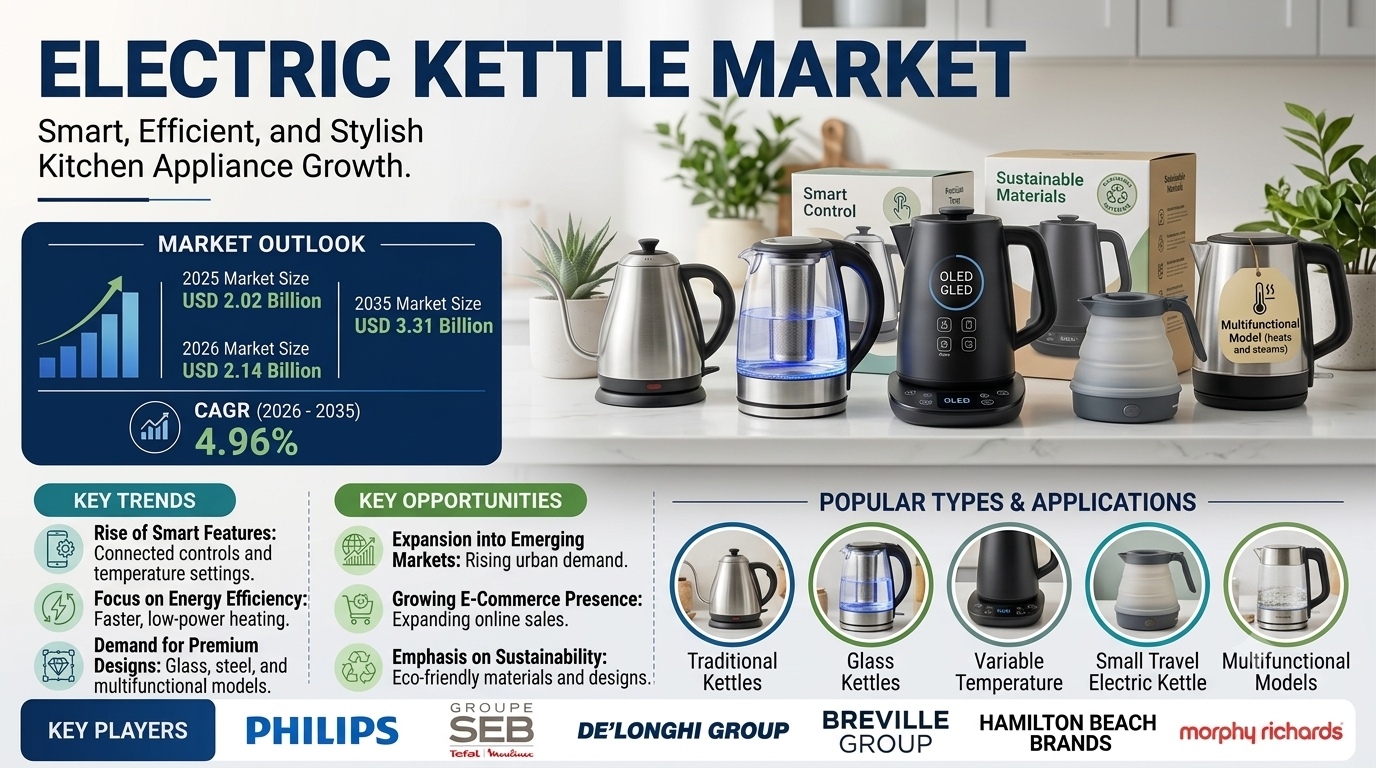
Electric Kettle Market
Global Electric Kettle Market to Reach USD 3.31 Billion by 2035 at a 4.96% CAGR, Driven by Connected Technology, E-Commerce and Eco-Friendly Product Innovation
Innovation in electric kettles is increasingly focused on smarter features, energy efficiency, and sustainable designs.”
NEW YORK, NY, UNITED STATES, August 26, 2026 /EINPresswire.com/ -- Global Electric Kettle Market Size is entering a new phase of product innovation as consumers increasingly prioritize convenience, energy efficiency, connected functionality and sustainable materials in everyday kitchen appliances. According to Market Research Future, the global Electric Kettle Market was valued at USD 2.02 billion in 2025 and is projected to reach USD 3.31 billion by 2035, advancing at a 4.96% CAGR between 2026 and 2035. The study covers the period from 2021 through 2035 and examines product types, materials, capacities, end users and regional demand patterns.— Market Research Future (MRFR)
The category is moving beyond the traditional concept of a simple countertop appliance used primarily for boiling water. Manufacturers are increasingly developing kettles that combine rapid heating with temperature precision, app connectivity, automated controls, improved safety and modern aesthetics. At the same time, environmental considerations are influencing decisions throughout the product lifecycle, from material sourcing and manufacturing to energy consumption, durability and end-of-life recycling.
Recent Developments:
Several recent developments demonstrate the direction of the category. Groupe SEB's recycled-steel initiative highlights the increasing importance of sustainable sourcing. Breville's Bluetooth-enabled gooseneck model demonstrates the convergence of connected technology and specialty coffee. De'Longhi's investment in IoT capabilities reflects the strategic value of software-driven appliances.
Regulatory changes in Europe are pushing companies toward greater energy efficiency, while Amazon Basics' expanded kettle portfolio illustrates growing private-label competition.
Together, these developments show that competition is no longer based solely on boiling speed and price. Material sourcing, connectivity, beverage-specific functionality, energy performance and ecosystem integration are becoming increasingly important.
Competitive Landscape:
The electric kettle industry is becoming increasingly competitive, with manufacturers focusing on smart functionality, product differentiation, energy efficiency, and sustainable design. Established brands are upgrading heating technologies and introducing connected features while continuing to offer affordable conventional models for value-conscious consumers.
In July 2024, De’Longhi expanded its technology capabilities by acquiring a 70% stake in a UK-based IoT firmware startup. The initiative aimed to support connected-appliance development across its kettle and coffee-machine businesses, highlighting the growing role of software and connectivity in household appliances.
leading Key Companies:
▪️Philips (Versuni)
▪️Groupe SEB (Tefal, Moulinex)
▪️De'Longhi Group
▪️Breville Group
▪️Spectrum Brands (Russell Hobbs)
▪️BSH Hausgeräte (Bosch, Siemens)
▪️Hamilton Beach Brands
▪️Conair Corporation (Cuisinart)
▪️Zojirushi Corporation
▪️Morphy Richards
▪️Smeg
▪️Fellow Products
Strategic partnerships are also gaining importance as companies seek access to specialized expertise in components, materials, software, and distribution. Such collaborations can help accelerate innovation, streamline product development, and respond efficiently to changing customer preferences. Overall, the competitive landscape is moving beyond traditional appliance manufacturing toward an interconnected ecosystem involving technology firms, component suppliers, retailers, and digital platforms.
Electric Kettle Market Segmentation:
▪️By Product Type:
Standard electric kettles lead with 44.3% share in 2025, supported by affordability and wide availability. Variable-temperature models reached USD 0.66 billion, driven by specialty beverage preparation. Smart/connected kettles are expanding at 10.6% CAGR, benefiting from IoT adoption and app-based controls.
▪️By Material:
Stainless steel dominates with 53.9% share in 2025, favored for durability and premium appeal. Plastic remains popular for affordable, lightweight designs, while glass kettles attract consumers seeking modern aesthetics and visible boiling.
▪️By Capacity:
The 1.0–1.5 L segment leads with 59.5% share in 2025, making it suitable for everyday household use. Smaller kettles are gaining demand among urban consumers, while larger capacities serve offices and hospitality applications.
▪️By End User:
Residential users account for 63.9% share in 2025, supported by everyday beverage preparation. Commercial and HoReCa demand is projected to grow at 6.0% CAGR, driven by hotels, cafés, and workplace facilities.
▪️By Distribution Channel:
Supermarkets and hypermarkets hold 40.0% share in 2025, benefiting from strong product visibility. Online sales are expanding fastest at 12.0% CAGR, supported by convenience, competitive pricing, and growing digital shopping adoption.
Product Segmentation Meets Diverse Consumer Needs:
Electric kettles are available across several product categories, including conventional, variable-temperature, smart, and specialized models. Basic kettles remain popular because they provide straightforward boiling functionality at accessible prices. Their simple operation makes them suitable for households and workplaces where advanced controls are not necessary. Variable-temperature products serve a more specialized audience by allowing users to select different heating levels according to beverage requirements.
Connected kettles represent the technology-focused portion of the category, offering app-based management, programmable functions, remote operation, and smart-home integration. Specialty designs are also creating niche opportunities. Gooseneck kettles, for example, are particularly relevant to pour-over coffee preparation because their narrow spouts provide greater control over water flow. Travel-friendly models appeal to consumers seeking portability. This broad product range enables manufacturers to address different lifestyles, budgets, beverage preferences, and levels of technology adoption.
Electric Kettle Market Enters a New Phase of Consumer-Led Innovation:
Electric kettles are evolving from basic water-heating appliances into versatile kitchen products used across homes, offices, hotels, cafés, and foodservice settings. Their ability to deliver hot water quickly makes them useful for tea, coffee, instant foods, and everyday preparation. Changing lifestyles are strengthening demand for compact, easy-to-operate appliances that save time and fit efficiently into modern kitchens. Smaller households are also encouraging interest in lightweight and space-saving designs with practical capacities.
Consumer expectations are also moving toward premium features. Buyers are increasingly considering temperature accuracy, heating speed, noise levels, safety functions, appearance, materials, and overall durability rather than focusing only on price. This shift is particularly noticeable among specialty tea and coffee users. Smart connectivity, energy efficiency, sustainable materials, and multifunctional capabilities are creating additional opportunities for manufacturers. Conventional models continue to serve value-conscious buyers, while technologically advanced products are helping brands establish premium categories and respond to increasingly sophisticated consumer requirements.
Smart Technology Changes the Role of the Electric Kettle:
Connected features are giving electric kettles a more advanced role within modern kitchens. Smart models can offer programmable temperatures, mobile-app controls, voice-assistant compatibility, scheduling, and customized preparation settings. These capabilities allow users to manage heating more precisely and conveniently. Temperature selection is especially valuable for tea and coffee enthusiasts who prefer different water temperatures depending on the beverage being prepared.
Connectivity also creates opportunities for manufacturers to link kettles with broader smart-home ecosystems. Integration with other connected kitchen appliances can provide consumers with a more unified digital experience. Although traditional kettles continue to dominate because of their simplicity and affordability, smart products are attracting technology-oriented consumers. Improvements in connectivity, software, sensors, and user interfaces could further strengthen this segment as smart-home adoption expands and consumers become more comfortable managing household appliances through mobile devices.
Get Full PDF Sample Copy of Report: (Including Full TOC, List of Tables & Figures, Chart) @
https://www.marketresearchfuture.com/sample_request/33139
Regional Market Share Analysis:
The global electric kettle industry shows varied regional dynamics, shaped by consumer preferences, urbanization, income levels, retail expansion, and smart-appliance adoption. North America remains a strong premium market, with the US accounting for 72.4% of regional share, while Canada is projected to grow at 5.8% CAGR. Europe continues to benefit from established tea and coffee consumption, with Germany holding 19.8% of regional share and the UK reaching USD 0.14 billion. Sustainability, premium designs, and energy-efficient appliances remain important demand drivers across the region.
Asia-Pacific represents a high-potential growth region, led by China with 38.5% of regional share, while India is projected to expand at 8.4% CAGR. South Korea is expected to record 6.2% CAGR, supported by smart-home adoption. In South America, Brazil leads with 58.2% regional share, while Argentina is projected to grow at 4.6% CAGR. The Middle East & Africa is supported by hospitality and tourism development, with Saudi Arabia accounting for 28.6% regional share and the UAE expected to grow at 5.5% CAGR. These regional trends highlight opportunities across premiumization, e-commerce, smart technology, and household appliance adoption.
Energy Efficiency and Regulation Influence Product Design:
Electricity consumption is becoming an important consideration as households and businesses look for appliances that provide strong performance without excessive energy use. Manufacturers are therefore working on faster heating, improved temperature management, automatic shut-off, insulation, and better power-control systems. These improvements can help reduce unnecessary energy consumption while maintaining convenient boiling performance.
Regulatory developments are also influencing appliance engineering, particularly in regions with stricter energy-efficiency requirements. Compliance can encourage manufacturers to improve standby-power management and overall electrical performance. Although meeting new requirements may increase research, testing, and development expenses, regulation can also stimulate innovation. Consumers are increasingly interested in products that combine rapid operation with efficient electricity use. Kettle manufacturers that successfully balance heating speed, energy consumption, safety, and affordability can create stronger value propositions in competitive markets.
Heating Technology Supports Faster and More Efficient Performance:
Heating systems remain central to electric kettle innovation. Modern products increasingly use concealed heating elements and flat-base designs that can simplify cleaning while reducing direct exposure to mineral deposits. These configurations can improve usability and contribute to longer-lasting appliance performance. Manufacturers are also working to improve temperature consistency and heating control to meet the expectations of consumers who require greater precision.
Competition is consequently shifting beyond simple wattage comparisons. Buyers are increasingly considering how evenly and quickly an appliance heats water, how accurately it maintains selected temperatures, and how easily it can be cleaned. Premium models designed for specialty beverages particularly benefit from advanced temperature management. Continued improvements in heating elements, sensors, insulation, and control systems can help manufacturers create products that offer greater functionality while maintaining the straightforward operation expected from everyday kitchen appliances.
Stainless Steel Remains a Major Material Choice:
Material selection plays an important role in kettle durability, appearance, maintenance, and consumer perception. Stainless steel remains widely preferred because it offers strength, corrosion resistance, durability, and a contemporary appearance. Its recyclability also supports growing interest in more responsible product construction. Premium manufacturers frequently use metal bodies to create a stronger perception of quality while maintaining reliable everyday performance.
Glass kettles appeal to consumers who prefer transparent designs that allow the boiling process to remain visible. Plastic continues to serve value-oriented categories because of its lightweight characteristics and manufacturing flexibility. However, increased attention to environmental impact and material safety may encourage manufacturers to reduce unnecessary plastic use and explore improved alternatives. Ceramic and other specialty materials remain smaller niches, often targeting design-conscious buyers. The availability of different materials allows brands to create products across multiple price levels and aesthetic preferences.
Capacity Choices Reflect Household Needs:
Kettle capacity is closely connected with household size, usage patterns, and available kitchen space. Medium-sized models are widely suitable for everyday household requirements because they can provide several cups of hot water without occupying excessive counter space. This makes them practical for consumers who want a balance between capacity, convenience, and energy-conscious operation.
Compact kettles can appeal to individuals, students, travelers, and people living in smaller homes or apartments. Their lower capacity can also help users heat only the amount of water required for a particular occasion. Larger models are better suited to families, offices, hotels, hospitality businesses, and other environments where multiple servings may be needed. Manufacturers can therefore address different consumer requirements through capacity variations, while features such as water-level indicators can help users measure and heat appropriate quantities.
Residential Demand Leads as Commercial Use Grows
Households continue to represent an important customer base for electric kettles because of their usefulness in preparing hot beverages and quick meals. Features such as cordless operation, automatic shut-off, boil-dry protection, easy-clean surfaces, water-level indicators, and ergonomic handles can improve everyday convenience. Compact designs are particularly suitable for modern kitchens where consumers are increasingly conscious of available counter space.
Commercial applications provide another avenue for industry expansion. Hotels, offices, cafés, restaurants, educational facilities, and other institutions require dependable appliances that can withstand frequent use. These buyers generally place greater emphasis on durability, capacity, maintenance, operating costs, and consistent performance. Specialty cafés may also require precision-focused kettles for coffee and tea preparation.
Opportunities:
The expanding popularity of specialty coffee is increasing interest in kettles designed for precise brewing. Pour-over coffee users often prefer gooseneck spouts because they provide greater control over water flow. Variable-temperature functions are also valuable because brewing preferences can differ depending on coffee type and preparation method. These features allow manufacturers to position kettles as specialized beverage equipment rather than basic water-heating appliances.
Tea enthusiasts represent another important premium segment. Different tea varieties can benefit from different water temperatures, making temperature-control technology attractive to consumers who prioritize preparation accuracy. The growing interest in home brewing is encouraging consumers to invest in appliances that deliver greater control and consistency. This convergence of beverage culture, design, and technology can support premium product development, particularly in markets where specialty cafés, home coffee preparation, and high-quality tea consumption continue to gain popularity.
Future Outlook:
The Electric Kettle industry is expected to maintain a positive trajectory through 2035, supported by evolving consumer lifestyles, smart-home adoption, convenience-focused appliances, and sustainability preferences. According to the provided outlook, the industry is projected to rise from USD 2.02 billion in 2025 to USD 3.31 billion by 2035, reflecting a 4.96% CAGR during 2026–2035. Future innovation is likely to emphasize intelligent controls, faster heating, energy efficiency, compact formats, and customized temperature settings. Connected kettles may increasingly integrate with mobile applications and wider smart-kitchen ecosystems, enabling users to manage brewing preferences and appliance functions more conveniently.
Sustainability is also expected to influence future product strategies, with manufacturers focusing on durable construction, energy-conscious operation, recyclable materials, repairability, and longer product lifecycles. Advances in automation, artificial intelligence, and machine learning could further support personalized beverage preparation by adapting settings to individual routines. Meanwhile, e-commerce will remain an important channel for reaching digitally engaged consumers and expanding product accessibility across regions.
Frequently Asked Questions?
1. What is the projected value of the Electric Kettle Market by 2035?
The global Electric Kettle Market is projected to reach USD 3.31 billion by 2035, compared with USD 2.02 billion in 2025.
2. What is driving demand for electric kettles?
Key factors include convenience, urban lifestyles, energy-efficiency requirements, smart-home adoption, specialty coffee and tea consumption, and expanding online retail.
3. Which technologies are shaping the future of electric kettles?
Connected controls, variable-temperature settings, improved heating elements, voice-assistant integration, energy-management systems and increasingly personalized appliance functions are shaping product development.
4. Why is sustainability becoming important for electric kettle manufacturers?
Manufacturers are responding to consumer and regulatory expectations by exploring recycled materials, energy-efficient designs, longer product lifecycles and more circular approaches to appliance production.
Discover More Research Reports By Market Research Future:
Foldable Electric Vehicle Market:
https://www.marketresearchfuture.com/reports/foldable-electric-vehicle-market-24200
Electric Hair Brush Market:
https://www.marketresearchfuture.com/reports/electric-hair-brush-market-24198
Electric Lunch Box Market:
https://www.marketresearchfuture.com/reports/electric-lunch-box-market-22936
Electric Tooth Polisher Market:
https://www.marketresearchfuture.com/reports/electric-tooth-polisher-market-22341
Electric Vegetable Chopper Market
https://www.marketresearchfuture.com/reports/electric-vegetable-chopper-market-41540
Market Research Future
Market Research Future
+1 855-661-4441
email us here
Legal Disclaimer:
EIN Presswire provides this news content "as is" without warranty of any kind. We do not accept any responsibility or liability for the accuracy, content, images, videos, licenses, completeness, legality, or reliability of the information contained in this article. If you have any complaints or copyright issues related to this article, kindly contact the author above.
